


Some riddles look innocent enough. A few words, a simple question, and an answer that seems almost too obvious. Five minutes later, you’re staring at the ceiling, questioning everything you thought you knew about numbers, footsteps, and common sense.
Welcome to the wonderfully frustrating world of hard riddles with answers!
Clever riddles have a peculiar talent for making perfectly reasonable people overlook perfectly reasonable solutions.
Some play tricks with language, others hide important clues in plain sight, and a few demand the kind of logical thinking that could make a detective reach for another cup of coffee.
Research published in Psychological Science in 2006 examined how people experience sudden insights during problem-solving. Researchers found that patterns of brain activity before a problem appeared were associated with how participants eventually solved it. Apparently, those satisfying little “aha!” moments have some fascinating science behind them.
Ready to give your brain something interesting to chew on?
1. The More You Take, the More You Leave Behind

Riddle: “The more you take, the more you leave behind. What am I?”
Answer: Footsteps.
Explanation
Walking seems like a rather straightforward activity, doesn’t it? You move forward, cover some distance, and eventually arrive somewhere.
Yet every step you take can leave a footprint behind.
More steps mean more footprints, which makes the answer surprisingly simple once you stop thinking about taking physical objects.
Why it’s tricky: Most people associate taking something with having less of it left. Here, taking more actually creates more evidence of your actions.
A gentle beginning, perhaps. Don’t get too comfortable.
2. The Number That Changes Its Mind
Riddle: “I’m an odd number. Take away one letter, and I become even. What am I?”
Answer: Seven.
Explanation
Seven is an odd number, but remove its first letter, “s,” and something interesting happens.
Seven becomes “even.”
No mathematical calculations are needed, and nobody has secretly changed the rules of arithmetic.
Why it’s tricky: Your brain naturally interprets “odd” and “even” as mathematical properties.
Yet the solution depends entirely on spelling.
Sometimes, difficult riddles are less interested in your mathematical abilities than in your willingness to play with words.
3. The Weighty Word Mystery

Riddle: “Forward, I am heavy. Backward, I am not. What am I?”
Answer: Ton.
Explanation
A ton is a unit of weight in everyday usage. In the United States, a short ton equals 2,000 pounds. Spell “ton” backward, however, and you get “not.”
Suddenly, something associated with considerable weight becomes a tiny word of negation.
Why it’s tricky: Nothing in the question explicitly tells you to reverse the letters. Instead, “forward” and “backward” quietly provide the necessary instructions.
A good word riddle rarely gives away its secret outright. It simply leaves the door unlocked and waits for someone to notice.
4. The Mystery of the Four Cars
Riddle: “Four cars reach a four-way intersection simultaneously, each arriving on a different road. All four move at once without colliding. How?”
Answer: They all turn right.
Explanation
Imagine four cars approaching an ordinary intersection, one in each direction.
At first, simultaneous movement sounds like a recipe for an expensive insurance claim.
But if every driver makes a right turn, each car follows a separate path without crossing another vehicle’s route.
No driver needs to perform an impossible maneuver. Everyone simply makes the same decision.
Why it’s tricky: Your imagination may picture four cars traveling straight across the intersection. Nothing in the riddle actually requires them to do that.
Of course, the solution assumes a conventional intersection with enough room for four simultaneous right turns and no conflicting pedestrian or bicycle traffic. Actual driving still requires following traffic signals and right-of-way rules.
5. Two Fathers, Two Sons, and Three Fish

Riddle: “Two fathers and two sons go fishing. Each catches exactly one fish, but they return home with only three fish. How is that possible?”
Answer: They’re a grandfather, a father, and a son.
Explanation
Nobody lost a fish, and nobody is hiding an extra person behind a tree.
Only three people went fishing:
- A grandfather, who is also a father.
- His son, who is both a father and a son.
- His grandson, who is a son.
Together, they make up two fathers and two sons, despite there being only three people.
Why it’s tricky: People often assume that two fathers and two sons must represent four separate individuals. Yet family relationships can overlap.
One person can occupy two roles at once, which is precisely what makes the puzzle work.
6. Three Switches, One Light Bulb
Riddle: “You’re outside a closed room containing a single light bulb. Three switches are mounted outside, but only one controls the bulb. You can operate the switches as often as you like, but you may enter the room only once. How can you identify the correct switch?”
Answer: Use both light and heat to identify the switch.
Explanation
At first, having three switches and only one opportunity to enter the room seems unfair.
Fortunately, a traditional incandescent light bulb provides more information than simply being on or off. Follow these steps:
- Turn on the first switch and leave it on long enough for the bulb to become warm.
- Turn off the first switch.
- Turn on the second switch.
- Leave the third switch untouched.
- Enter the room and examine the bulb’s condition.
Why it’s tricky: Most people consider a light bulb useful only when producing light. Heat provides an additional clue that solves the mystery.
A technical detail matters here.
According to the U.S. Department of Energy, traditional incandescent bulbs release around 90% of their energy as heat.
Modern LED bulbs behave differently and generally produce much less accessible heat, so the classic solution isn’t reliable with every type of bulb.
For an actual demonstration, use a safe temperature measurement method rather than touching a potentially hot bulb.
One room, three switches, and a reminder that even ordinary objects can carry unexpected information.
7. The Bridge Crossing Conundrum

Riddle: “Four people need to cross a narrow bridge at night. One takes 1 minute, another takes 2 minutes, the third takes 7 minutes, and the fourth takes 10 minutes. Only two people can cross at once, and everyone needs the same flashlight to cross safely. When two people cross together, they travel at the slower person’s pace. What’s the fastest possible time for everyone to reach the other side?”
Answer: 17 minutes.
Explanation
Every crossing must account for the flashlight, and someone must bring it back whenever people are still waiting.
Sending the fastest person back and forth with everyone might sound sensible, but there’s a more efficient arrangement.
Here’s the winning sequence:
| Move | Time | Total elapsed |
| 1-minute and 2-minute people cross | 2 minutes | 2 minutes |
| 1-minute person returns | 1 minute | 3 minutes |
| 7-minute and 10-minute people cross | 10 minutes | 13 minutes |
| 2-minute person returns | 2 minutes | 15 minutes |
| 1-minute and 2-minute people cross | 2 minutes | 17 minutes |
Everyone arrives safely in exactly 17 minutes.
Why it’s tricky: Using the fastest person as the only flashlight carrier seems efficient, but that approach takes 21 minutes.
Pairing the two slowest travelers allows them to complete their crossing together, avoiding separate 7-minute and 10-minute trips.
8. The Two Doors and Two Guards
Riddle: “You’re trapped in a room with two doors. One leads to freedom, while the other leads to danger. Each door has a guard. One guard always tells the truth, and the other always lies. You don’t know which is which, and you may ask only one yes-or-no question to one guard. How do you identify the safe door?”
Answer: Ask either guard, “If I asked the other guard if the left door leads to freedom, would they say yes?”
If the answer is yes, choose the right door. If the answer is no, choose the left door.
Explanation
Here’s where the mystery becomes particularly satisfying.
Imagine asking the truthful guard. Since the other guard always lies, the truthful guard accurately reports the lie the other would tell.
Now imagine asking the lying guard. Since the other guard always tells the truth, the liar gives you the opposite of that truthful answer.
Either way, the response points you toward the dangerous door when interpreted as an answer about the left door.
Choosing the opposite gives you the correct result.
Why it’s tricky: You’re dealing with two unreliable possibilities, but asking about the other guard’s answer effectively cancels the uncertainty.
Careful wording turns the guards’ different behaviors into a predictable system.
One question, two possible doors, and a surprisingly dependable answer.
9. The Nine Coins Mystery
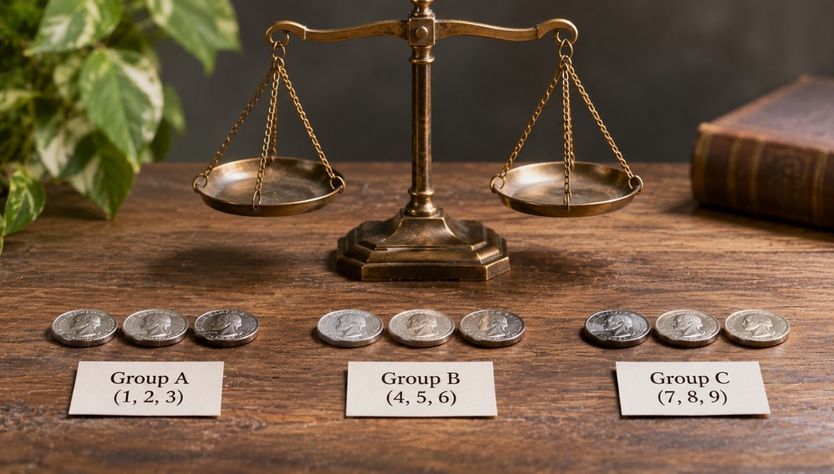
Riddle: “Nine coins look completely identical, but one is slightly lighter than the others. You have a balance scale and may use it only twice. Can you identify the lighter coin?”
Answer: Yes. Divide the coins into three groups of three.
Explanation
A balance scale compares the weights on its two sides, making it perfect for narrowing down possibilities.
Start by separating the coins into three groups:
- Group A contains coins 1, 2, and 3.
- Group B contains coins 4, 5, and 6.
- Group C contains coins 7, 8, and 9.
First weighing
Place Group A on one side of the scale and Group B on the other.
If they balance, the lighter coin must belong to Group C.
If one side rises, the lighter coin belongs to the group on that side.
Either result leaves exactly three possible coins.
Second weighing
Take two coins out of the suspected group and weigh them against each other.
If one side rises, you’ve found the lighter coin.
If they balance, the third coin must be lighter. Mystery solved in exactly two weighings.
10. The Three Gods Puzzle
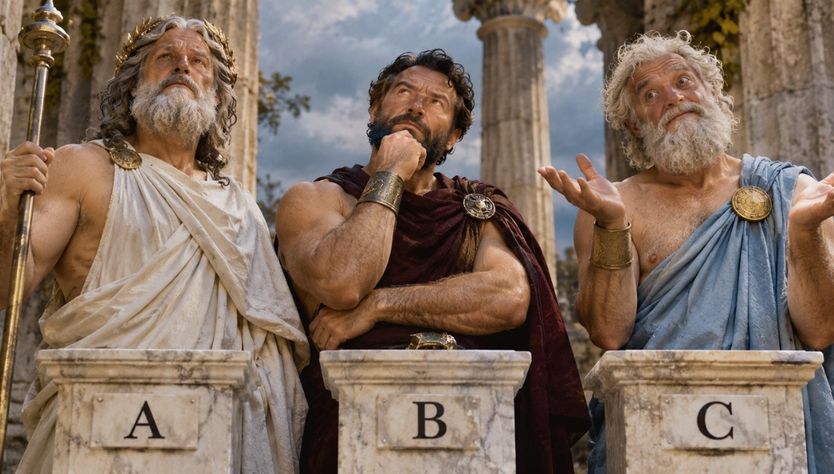
Riddle: “Three gods, named A, B, and C, have mysterious identities. One always tells the truth, one always lies, and the third answers randomly. They understand English but respond using only two words, ‘da’ and ‘ja.’ One means yes and the other means no, but you don’t know which. Can you identify all three gods by asking just three yes-or-no questions?”
Answer: Yes. Carefully constructed questions can reveal all three identities, even without knowing the meaning of either response.
Explanation
Welcome to the final challenge.
Originally presented by logician George Boolos in the 1996 paper The Hardest Logic Puzzle Ever, this puzzle combines three separate problems.
You don’t know which god is truthful, which one lies, or which one answers randomly. You also don’t know the meaning of their two words.
Fortunately, there’s a clever way to overcome these obstacles.
Step #1. Learn the special question format
For any statement, you can ask: “If I asked you [statement], would you say ‘ja’?”
For a god who always tells the truth or always lies, this question creates a dependable rule:
– A response of “ja” means the statement is true.
– A response of “da” means the statement is false.
Surprisingly, this works regardless of which word means yes.
Why?
A truthful god accurately describes the answer they would give. A lying god lies about the answer they would give. Meanwhile, the double-question structure compensates for the unknown language.
In effect, the two complications cancel each other out.
However, the technique isn’t dependable when directed at the Random god.
Step #2. Ask the first question
Address God A. Question 1: “If I asked you ‘Is B Random?’ would you say ‘ja’?”
Interpret the response as follows:
- If A says “ja,” God C is guaranteed not to be Random.
- If A says “da,” God B is guaranteed not to be Random.
If A happens to be Random, both B and C are reliable in the sense that neither is Random.
If A isn’t Random, the special question reveals the truth about B, allowing you to identify a different god who definitely isn’t Random.
Either way, you’ve found a god who consistently tells the truth or consistently lies.
Call that god X.
Step #3. Ask the second question
Address God X.
Question 2: “If I asked you ‘Are you the Truth god?’ would you say ‘ja’?”
Since X isn’t Random, the special question works reliably.
- If X answers “ja,” X is the Truth god.
- If X answers “da,” X is the Liar god.
You now know the identity of one god with certainty.
Two questions down. One to go.
Step #4. Ask the final question
Address God X again.
Question 3: “If I asked you ‘Is A Random?’ would you say ‘ja’?”
Once again, the response provides dependable information.
- If X says “ja,” God A is Random.
- If X says “da,” God A isn’t Random.
If A is Random, the remaining unidentified god must have the other nonrandom identity.
If A isn’t Random, the third god, the one who isn’t A or X, must be Random. A then has the other nonrandom identity.
All three gods have now been identified.
Why it’s nearly impossible: Solving the puzzle requires handling several layers of uncertainty simultaneously.
Ordinary yes-or-no questions aren’t enough. Instead, you must construct questions that make truthful and dishonest answers behave predictably, then use that information to eliminate possibilities.
Under Boolos’s original rules, three questions is also the minimum. Two yes-or-no answers can produce only four different outcomes, which isn’t enough to tell apart the six possible ways the three gods could be arranged.
Quite a lot of trouble for three little questions, wouldn’t you agree?
Did You Crack Them All?
Ten riddles, several unexpected answers, and at least one light bulb with more secrets than anyone expected.
Perhaps you solved the footsteps mystery immediately. Maybe the nine coins demanded a little extra attention. Or perhaps those three mysterious gods are still causing trouble.
No matter how many answers you found, the real pleasure of hard riddles lies in discovering how easily a familiar question can fool us.
So, which puzzle deserves another round? Pick your favorite, share it with a friend, and see how long they can resist asking for a hint.
And whenever you’re ready for another mystery, Hmmporium has plenty more curious questions waiting to be cracked.